



The first chilly morning of fall has a funny way of exposing every weakness in a heating system. You turn up the thermostat, wait for that familiar rush of warm air… and nothing happens. Or the furnace starts, shuts down, starts again, and suddenly you are standing next to a vent wondering whether that noise has always been there.
This is exactly why furnace maintenance matters.
A furnace does not need constant attention, but ignoring it for years is not a great plan either. Dust collects. Filters clog. Moving parts wear. Burners get dirty. Electrical connections can loosen. Small problems that are inexpensive to address during routine service may become inconvenient breakdowns when the system is working hardest.
For many U.S. homeowners, early fall is a convenient time to deal with heating maintenance before colder weather arrives. In warmer parts of the country, the schedule may look different because the furnace runs less often. The basic idea stays the same: inspect the system before you depend on it every day.
And no, furnace maintenance does not mean taking the entire machine apart yourself.
Some tasks are perfectly reasonable for homeowners. Others belong with a qualified HVAC technician, especially anything involving gas combustion, burners, internal electrical components, or carbon monoxide safety.
Here is how to tell the difference.
What Counts as Furnace Maintenance?
Furnace maintenance is a combination of basic homeowner care and professional inspection.
The homeowner side is mostly about keeping airflow clear, noticing changes, and avoiding obvious problems. That means replacing or checking filters, keeping supply and return vents open, maintaining clearance around the furnace, and paying attention to unusual smells or sounds.
Professional maintenance goes deeper. A technician can inspect combustion components, electrical connections, safety controls, blower operation, venting, and other internal parts that should not be casually adjusted.
Both sides matter.
A new filter will not fix a damaged heat exchanger. And a perfectly serviced furnace can still struggle if someone blocks half the return vents with furniture.
Why Regular Furnace Maintenance Matters
Heating equipment tends to fail at inconvenient times because that is when it is under the greatest load. A furnace that seemed fine during a mild October afternoon may behave very differently after running through several freezing nights.
Routine care helps catch problems earlier and keeps the system operating under cleaner conditions.
| Maintenance Goal | Why It Matters | Who Usually Handles It |
|---|---|---|
| Maintain airflow | Restricted airflow can reduce comfort and strain the blower | Homeowner and technician |
| Inspect combustion | Helps identify unsafe or inefficient operating conditions | Qualified technician |
| Check safety controls | Confirms important protective components are functioning | Qualified technician |
| Keep equipment clean | Dust and debris can interfere with performance | Homeowner and technician |
| Spot wear early | Small issues may be easier to address before a breakdown | Qualified technician |
| Confirm proper venting | Combustion gases need a safe path out of the home | Qualified technician |
There is also the comfort factor.
A furnace may technically be “working” while doing a pretty poor job. Rooms can heat unevenly. The blower may run longer than expected. The system may cycle too often. Sometimes homeowners get used to these changes because they happen gradually.
Annual attention gives you a chance to notice what has shifted.
How Often Should a Furnace Be Maintained?
For many residential systems, a professional inspection once a year is a common maintenance schedule. Fall is popular because homeowners want the furnace checked before heating season.
That does not mean the calendar is the only thing that matters.
A system that runs heavily through a long northern winter may need more filter attention than a furnace in a mild climate. Homes with pets, renovation dust, smoking, or high indoor particle levels may also load filters faster.
The equipment manufacturer’s maintenance instructions should be your starting point because furnace designs differ.
And if your system has a warranty, read the warranty terms rather than assuming all maintenance requirements are identical.
The Furnace Filter Is the Easy Part People Forget
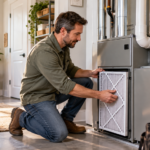
If you do only one basic furnace maintenance task consistently, pay attention to the filter.
The filter helps keep airborne particles from moving freely through the heating and cooling system. As it loads with dust, airflow becomes more restricted.
But there is no useful universal rule saying every filter must be replaced every 30 days.
A thin disposable filter may need attention much sooner than a larger media filter. A home with several shedding pets can load a filter faster than a low-occupancy home without animals.
So check the actual condition instead of blindly following a number printed on a calendar.
Useful filter habits include:
- Check the filter regularly during months when the HVAC system runs heavily.
- Replace or clean it according to the furnace and filter manufacturer’s instructions.
- Install disposable filters in the correct airflow direction.
- Do not assume a thicker or higher-rated filter is automatically better for every system.
- If the filter becomes dirty unusually fast, look for construction dust, pet hair, return-air leaks, or another source of heavy particles.
- Keep a spare correct-size filter at home so replacement does not become a three-week project.
One common mistake is buying the most restrictive filter available because the packaging sounds impressive.
More filtration can be useful, but the furnace and duct system must be able to handle the pressure drop. If you want to change to a very different filter type, ask an HVAC professional whether it suits your system.
Do Not Block Supply and Return Vents
A couch over a return grille can quietly cause more trouble than people expect.
Your furnace depends on air moving through the system. Supply registers deliver conditioned air into rooms, while return grilles send room air back toward the HVAC equipment.
Closing many registers or blocking returns changes airflow.
People sometimes close vents in unused rooms because it feels like an easy way to save energy. Residential duct systems are not always designed to work well with large portions of their airflow intentionally blocked.
Keep registers reasonably open unless an HVAC professional has designed the system for a different setup.
And yes, check behind furniture. That giant bookcase may be sitting in front of the return nobody remembers exists.
Keep the Furnace Area Clear
A furnace room has an odd tendency to become storage space.
Holiday boxes appear. Paint cans migrate in. Someone puts a basket of laundry next to the equipment because it is “just for tonight.” Six months later, the furnace has become the center of a small warehouse.
That is not ideal.
Heating equipment needs appropriate clearance for service, ventilation, and safety. Combustible materials should not be piled around it.
Do not store gasoline, solvents, or other flammable materials near a furnace.
The exact clearance requirements depend on the appliance and installation, so follow the manufacturer’s instructions and local requirements.
Check the Thermostat Before Blaming the Furnace
A surprising number of “broken furnace” calls start with something very simple.
Before assuming the heating system has failed, look at the thermostat.
Is it set to heat?
Is the target temperature above the current room temperature?
If the thermostat uses batteries, are they still good?
Does the display look normal?
Was a schedule accidentally changed?
Smart thermostats add another layer. Wi-Fi problems may affect remote control, although many thermostats can still operate basic heating locally.
If the furnace starts normally after correcting a thermostat setting, congratulations. You just completed the cheapest HVAC repair possible.
What a Professional Furnace Tune-Up May Include
The details depend on furnace type, manufacturer, age, and system design, but a qualified technician typically performs a broader inspection than a homeowner should attempt.
That may involve checking:
- Burner operation and ignition components
- Electrical connections and operating controls
- Blower components and airflow
- Safety switches and limit controls
- Vent and flue condition where applicable
- Combustion performance on fuel-burning equipment
- Visible signs of corrosion, overheating, or deterioration
- Condensate drainage on high-efficiency condensing furnaces
- Filter condition and general system cleanliness
Some systems require additional manufacturer-specific checks.
The useful part is not simply having someone “look at it.” A proper maintenance visit should involve actual inspection of the equipment and its operating condition.
Gas Furnace Maintenance Deserves Extra Respect
Natural gas furnaces are common in American homes, and they can provide reliable heat for many years.
But combustion equipment is not the place for experimental DIY repairs.
Burners, gas valves, ignition systems, flame sensors, pressure switches, venting, and combustion air all affect how the furnace operates.
If you smell gas, do not start taking panels off and searching for the leak.
Leave the area and follow the emergency instructions from your gas utility or local emergency services. Avoid creating sparks or operating switches if a gas leak is suspected.
Likewise, recurring ignition problems deserve diagnosis rather than repeated resetting.
Carbon Monoxide Safety Is Part of Furnace Care
Any home with fuel-burning equipment needs to take carbon monoxide seriously.
Carbon monoxide is colorless and odorless, so you cannot depend on smell to warn you.
Working carbon monoxide alarms should be installed and maintained according to applicable codes, manufacturer instructions, and local guidance.
Do not treat a carbon monoxide alarm as an annoying appliance that needs to be silenced.
If an alarm activates, follow its emergency instructions and local safety guidance.
A furnace inspection does not replace carbon monoxide alarms, and alarms do not replace furnace inspection. They are different layers of protection.
What Is a Heat Exchanger?
The heat exchanger is a critical part of many furnaces.
Combustion occurs on one side while household air passes around the exchanger and absorbs heat. The design keeps combustion gases separate from the air distributed through the house.
Because of that role, heat exchanger condition matters.
You may hear homeowners talk casually about “checking for cracks,” but this is not a good DIY inspection. Internal damage may be difficult to see, and proper evaluation requires knowledge of the appliance.
If a technician identifies a heat exchanger concern, ask for a clear explanation of what was found and what the recommended next step is.
Short Cycling Is Not Something to Ignore
A furnace that starts and stops unusually often is short cycling.
Sometimes the cause is relatively simple, such as restricted airflow from a dirty filter. Other possibilities include thermostat issues, overheating, flame-sensing problems, airflow problems, or equipment that is not operating correctly.
The key phrase is “unusually often.”
Heating cycles naturally vary with outdoor temperature, insulation, thermostat settings, and system size. There is no single perfect cycle length that applies to every home.
But if the behavior has clearly changed, pay attention.
Strange Furnace Noises: Which Ones Matter?
Every furnace makes some noise.
You may hear the inducer start, the burners ignite, metal expand as it warms, the blower come on, and ductwork move slightly as pressure changes.
That is different from a new banging, grinding, scraping, squealing, or rattling sound.
| Sound | Possible Explanation | What to Do |
|---|---|---|
| Light clicking at startup | Can be part of normal ignition sequence | Watch for changes or failure to ignite |
| Rattling | Loose panel, duct, or another component | Schedule inspection if persistent |
| Squealing | Possible blower or motor-related issue | Have system checked |
| Grinding | Possible mechanical problem | Shut system down and seek service |
| Booming at ignition | Potential burner or ignition issue | Professional inspection recommended |
| Popping from ducts | Duct expansion or pressure changes | Investigate if excessive or new |
The best clue is change.
If your furnace has sounded one way for five years and suddenly starts making a new noise, something changed.
What About High-Efficiency Furnaces?
High-efficiency condensing furnaces create water as part of their normal operation.
That moisture needs to drain correctly.
Condensate tubing, traps, pumps, and drains can become blocked or fail. A condensate problem may shut the furnace down through a safety control or create water where you definitely do not want it.
If your furnace has plastic vent pipes and a condensate drain, include that drainage system in professional furnace maintenance.
Homeowners can also keep an eye out for unexpected water around the unit.
Water near a furnace is not something to casually mop up for six months without finding the source.
Outdoor Vent Openings Need Attention Too
Some high-efficiency furnaces vent through pipes that terminate through an exterior wall.
Leaves, snow, ice, insect nests, and other debris can interfere with those openings.
Do not modify the vent termination, but visually check that it remains unobstructed.
After heavy snow, it is especially worth making sure vent openings have not been buried.
Never assume a furnace shutdown during severe weather is random when snow has piled against the side of the house.
Should You Clean Furnace Burners Yourself?
For most homeowners, no.
Videos online can make burner cleaning look like brushing crumbs off a toaster. It is not the same thing.
Burner position, flame behavior, ignition, gas pressure, combustion, and venting all interact.
Routine observation is fine. Disassembling combustion equipment without the right training is not.
If burners need cleaning, let a qualified technician handle it.
How to Prepare the Furnace for Heating Season
A simple pre-season check does not take long.
- Install or inspect the correct furnace filter.
- Clear storage and clutter away from the equipment.
- Make sure supply registers and return grilles are not blocked.
- Test the thermostat in heating mode before the first truly cold day.
- Confirm carbon monoxide alarms are present and functioning according to their instructions.
- Look around the furnace for water, corrosion, loose panels, or obvious damage.
- Check accessible outdoor intake and exhaust openings for visible obstructions.
- Schedule professional service if maintenance is due or if anything seems abnormal.
Doing this in September or early fall is convenient in many parts of the U.S. because HVAC companies may be easier to schedule before the first major cold snap sends half the neighborhood calling at once.
Can Furnace Maintenance Lower Energy Bills?
Sometimes, but be realistic about the claim.
A severely clogged filter, airflow problem, dirty component, or malfunction can certainly cause poor operation. Correcting problems may improve performance.
But annual maintenance is not a magic switch that automatically cuts every heating bill by some dramatic percentage.
Your utility costs also depend on weather, thermostat settings, insulation, air leakage, local fuel prices, home size, duct condition, and furnace efficiency.
If heating costs jump unexpectedly, compare usage as well as the dollar amount. A higher bill can come from higher energy prices even when your furnace is using the same amount of fuel.
When Maintenance Turns Into Repair
Maintenance keeps a healthy system healthy. It does not make worn components immortal.
During an inspection, a technician may find a failing motor, ignition problem, damaged safety component, venting issue, or another defect that needs repair.
That does not mean maintenance “caused” the problem.
It means the inspection found something before it became even more inconvenient.
If a repair recommendation is expensive, ask what failed, whether the furnace can safely operate, what the repair involves, and whether there are alternatives.
When Should You Consider Furnace Replacement?
Age alone does not dictate replacement.
An older furnace that has been maintained and remains in good condition can be a different situation from a newer system with repeated major failures.
Replacement becomes more worth discussing when repairs are becoming frequent, key components are deteriorating, the furnace cannot reliably heat the home, or a major repair approaches the value of investing in new equipment.
Efficiency may also matter, especially if the existing system is very old.
But do not replace a working furnace just because someone says, “It is over ten years old, so it is done.”
Ask for the actual condition and repair history.
What About Furnace Maintenance Plans?
HVAC companies often sell service agreements or maintenance memberships.
These can be useful, especially for homeowners who prefer not to remember annual scheduling themselves.
But read what you are buying.
One plan might include one furnace inspection. Another may include both heating and cooling visits, priority service, discounted repairs, or filter replacement.
Compare the cost with paying for service individually.
The useful question is not “Is a maintenance plan good?”
It is “What does this specific plan include, and will I actually use those benefits?”
Do New Furnaces Still Need Maintenance?
Yes.
New equipment still has filters, electrical parts, blowers, safety controls, drains, venting, and other components that need attention.
A new furnace may be less likely to suffer age-related failure, but that does not mean it should be ignored.
Also check warranty requirements. Some manufacturers require documentation of maintenance under certain warranty terms.
What Homeowners Should Not Do
There is a big difference between maintenance and improvisation.
Changing a filter is maintenance.
Adjusting gas pressure because a video said the flame “looks wrong” is not.
Do not bypass safety switches, modify burners, drill holes into furnace cabinets, change venting arrangements, or repeatedly reset a system that keeps shutting down.
Safety controls usually shut equipment down for a reason.
If you keep forcing the furnace to restart without finding that reason, you may turn a manageable problem into a dangerous one.
FAQ About Furnace Maintenance
How often should furnace maintenance be done?
A professional furnace inspection once a year is common for residential systems, although manufacturer guidance and system conditions should come first. Many homeowners schedule service before heating season.
How often should I change the furnace filter?
There is no single schedule that fits every home. Check the filter regularly and replace or clean it according to its condition and manufacturer instructions. Pets, dust, filter size, and system runtime all affect how quickly it loads.
Can I perform furnace maintenance myself?
You can handle basic tasks such as filters, keeping vents open, clearing clutter, checking thermostat settings, and watching for obvious problems. Combustion, gas, internal electrical, and safety-system work should be left to qualified professionals.
What is included in professional furnace maintenance?
It varies by equipment and contractor, but service may include inspection of burners, ignition, blower operation, electrical connections, safety controls, venting, combustion, filter condition, and condensate drainage where applicable.
Why does my furnace keep turning on and off?
Frequent short cycling can have several causes, including airflow restrictions, thermostat problems, overheating, ignition issues, or other equipment faults. A dirty filter is worth checking, but persistent cycling deserves professional diagnosis.
Should I turn off my furnace if it makes a strange noise?
If you hear grinding, loud booming, scraping, or another severe new sound, shutting the furnace down and arranging service is sensible. Normal startup sounds are different from a sudden mechanical noise that was not present before.
Is furnace maintenance worth paying for?
For most homes, routine inspection is a practical way to check safety, cleanliness, airflow, combustion, and component condition before heating season. It cannot prevent every future failure, but it may identify developing problems earlier.
Conclusion: Small Habits Make Furnace Season Easier
Furnace maintenance is not complicated from the homeowner’s side.
You do not need to spend weekends dismantling heating equipment or memorizing the wiring diagram inside the service panel.
Most of your job is surprisingly ordinary.
Keep the filter in good condition.
Do not bury the furnace behind storage boxes.
Keep vents clear.
Pay attention when the system suddenly sounds, smells, or behaves differently.
And schedule qualified service when the furnace needs a deeper inspection.
That last part matters because a furnace is not simply a fan blowing warm air. Fuel-burning systems involve combustion, ventilation, ignition, electricity, and safety controls working together.
When all of those pieces behave properly, the furnace becomes almost invisible. You hear it start, warm air comes through the vents, the thermostat reaches its setting, and life continues.
That boring reliability is exactly what you want.
Do not wait for the coldest night of the year to discover the furnace has been trying to tell you something since spring.
A dirty filter, unusual startup noise, water near a condensing furnace, or repeated short cycling is easier to investigate before temperatures drop.
It also helps to keep a simple record of service dates and repairs. You do not need a complicated spreadsheet. A note in your phone with the date, filter size, technician visit, and any repaired parts is enough.
That history becomes surprisingly useful later.
If the blower motor fails twice in three years, you will know.
If the furnace suddenly begins needing frequent repairs after a long period of reliable service, you will have context when deciding whether replacement makes sense.
And when you sell the house, having maintenance records can be useful for answering questions about the heating system.
There is another benefit to regular attention: you become familiar with what “normal” looks like.
You know how long the furnace usually runs.
You know what startup sounds like.
You know whether the room above the garage has always been a little cooler.
That makes real changes easier to notice.
The goal is not to become suspicious of every click coming from the mechanical room. Furnaces make noises. Ductwork moves. Metal expands and contracts.
But new behavior deserves curiosity.
If something smells like gas, treat it seriously.
If a carbon monoxide alarm activates, follow its emergency guidance.
If the furnace repeatedly shuts down, do not keep resetting it indefinitely.
If a technician identifies a safety problem, ask questions until you understand what was found.
Good furnace maintenance lives somewhere between neglect and obsession.
You do not need to hover over the equipment every week.
You also should not forget it exists until warm air stops coming out of the vents.
For many U.S. homes, checking things in early fall works well. Replace the filter if needed, clear the area, test the thermostat, check alarms, and schedule professional service if it is due.
That little bit of preparation is much easier than trying to find an available HVAC company during the first hard freeze.
And if your furnace passes inspection and runs quietly all winter?
Perfect.
The best heating system is usually the one you barely have to think about.

Leave a Reply